Case Study

Texas Oncology

Unifying a Statewide Cancer Care Ecosystem Into One Platform That Helps Patients Find Care and Take the Next Step

01.

OVERVIEW

Cancer patients and their caregivers rarely arrive at a website calm, certain, or with time to spare. They arrive worried, often on a phone, looking for one thing: a clear path to care. For one of the nation’s largest community-based cancer care providers, the digital experience needed to meet that moment, across more than 250 locations and a family of specialized service lines.

Alliance Innovations led the strategy, design, and development of a modern digital ecosystem for Texas Oncology. The project included a complete rebuild of the organization’s primary digital presence at texasoncology.com, along with four specialized microsites supporting key service lines: Proton Therapy, Breast Care, Urology, and Colorectal Care. The result is a unified, scalable, and highly governed platform that delivers enterprise-wide consistency while preserving the flexibility each service line needs to tell its own story.

02

HIGHLIGHTS

  • A complete rebuild of texasoncology.com plus four service-line microsites on a single, shared platform
  • A unified component architecture that reuses shared elements across the main site and every microsite, reducing duplication and operational overhead
  • Centralized, governed content management, author once, publish accurately across multiple digital properties
  • A deliberate answer-engine strategy that restructured previously scattered content for modern, AI-driven search
  • A 646% increase in new users from organic search in the first weeks after launch
  • 1.2M sessions (+332%) and an accessibility score of 97, up from 68
  • Average time to request an appointment cut from 7:58 to 1:15, an 84.8% reduction

03

THE CHALLENGE

Texas Oncology had grown into one of the largest community-based cancer care networks in the country but its digital presence hadn’t kept pace with its scale. The main website and its specialty service lines had evolved separately over time, leaving patients to navigate a fragmented set of experiences and leaving internal teams to maintain them with disconnected tools and duplicated effort.

The impact was meaningful:

  • Content and provider information were scattered across properties, making it harder for patients to find the right care and harder for search engines to surface it
  • Teams maintained overlapping content in multiple places, creating version drift and governance risk across patient-facing communications
  • Inconsistent structure and navigation slowed patients down at the exact moments they needed to move quickly finding a provider, locating a center, requesting an appointment
  • Each service line wanted room to speak to its own audience, but there was no shared foundation to make that possible without rebuilding from scratch every time

For an organization whose mission depends on connecting patients to evidence-based care quickly, these weren’t cosmetic problems. They were barriers between people and the next step in their care.

04

THE SOLUTION

Alliance Innovations partnered with Texas Oncology to design and build a connected digital ecosystem engineered for both consistency and flexibility — one platform that could serve the enterprise, empower each service line, and scale with the organization’s future. Our team led the effort from strategy through design, development, QA, and launch.

One Platform, Shared by Design

We built the main website and all four microsites on a single, unified platform with a shared component architecture. Common elements are built once and reused everywhere, so the entire ecosystem maintains a consistent, high-quality user experience while dramatically reducing duplication and the operational overhead of maintaining separate sites. New properties and features can be stood up faster because the foundation already exists.

Centralized, Governed Content Management

The platform enables teams to enter and update content in a single location and publish it across multiple digital properties. This keeps patient-facing communications accurate, synchronized, and properly governed across the entire ecosystem — eliminating the version drift and duplicated effort that came with managing each property in isolation.

Built to Answer, Not Just Rank

Patients increasingly expect direct, trustworthy answers — from search engines, AI-powered tools, and voice assistants alike. We turned previously scattered content into a structured, answer-ready foundation: structured content and schema markup, FAQ optimization, entity-based SEO, and clean, consistent provider and location data, all optimized for AI-generated answers and voice search. The goal was never just visibility; it was helping people get clear, credible cancer-care answers at the moment they need them.

Findability Across 250+ Locations

With a footprint of more than 250 locations, helping patients and referring physicians find the right provider is mission-critical. The rebuilt provider directory lets users search by what actually matters to them and move quickly from search to a rich, complete provider profile — with appointment access kept visible throughout, so finding the right specialist and taking the next step happen in the same flow.

Accessible by Design

A cancer-care experience has to work for everyone, including patients and caregivers using assistive technology. Accessibility was built into the platform rather than bolted on afterward, raising the site’s measured accessibility score from 68 to 97 and making the experience usable for people of all abilities.

Fast, Mobile-First, and Built to Last

Engineered on a modern headless architecture, the platform delivers strong Core Web Vitals across desktop and mobile — fast load times, minimal layout shift, and responsive interactions — for patients who are often searching urgently and on the go. The result is an enterprise-grade foundation built for performance, scalability, and long-term evolution.

05

THE RESULTS

Launched in November 2025, the new ecosystem delivered measurable impact within its first weeks live — across acquisition, engagement, accessibility, and the moments that matter most to patients.
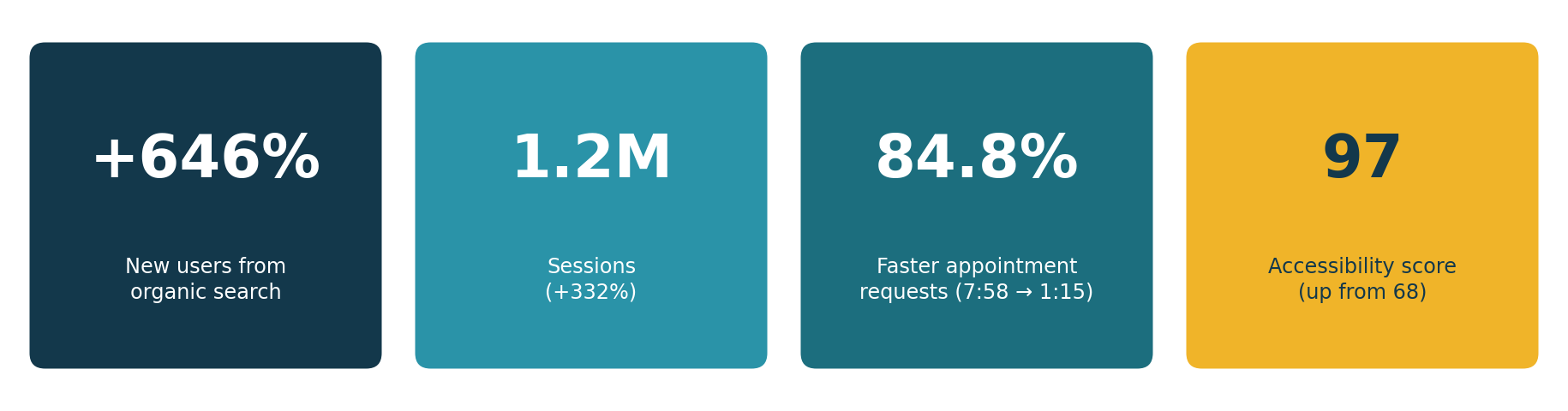
Texas Oncology - Stats for users.

In the first weeks after launch, new users from organic search rose 646% as the restructured, answer-ready content began surfacing where patients search. Overall, the platform recorded 1.2 million sessions, a 332% increase over the prior experience.
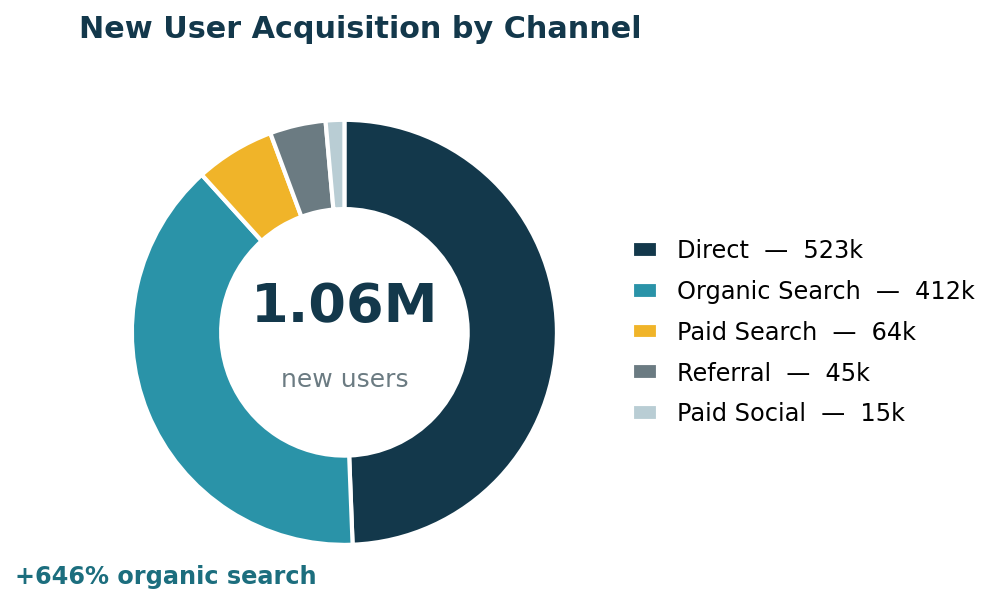
Texas Oncology - New user Acquisition by Channel

Patients didn’t just arrive — they engaged and acted. Average time to request an appointment fell from 7:58 to 1:15, an 84.8% reduction, while the redesigned Request Appointment page saw a 923% increase in active users. Deep engagement climbed as well, with 805,000 users scrolling to 90% of page length, up 32.3%.
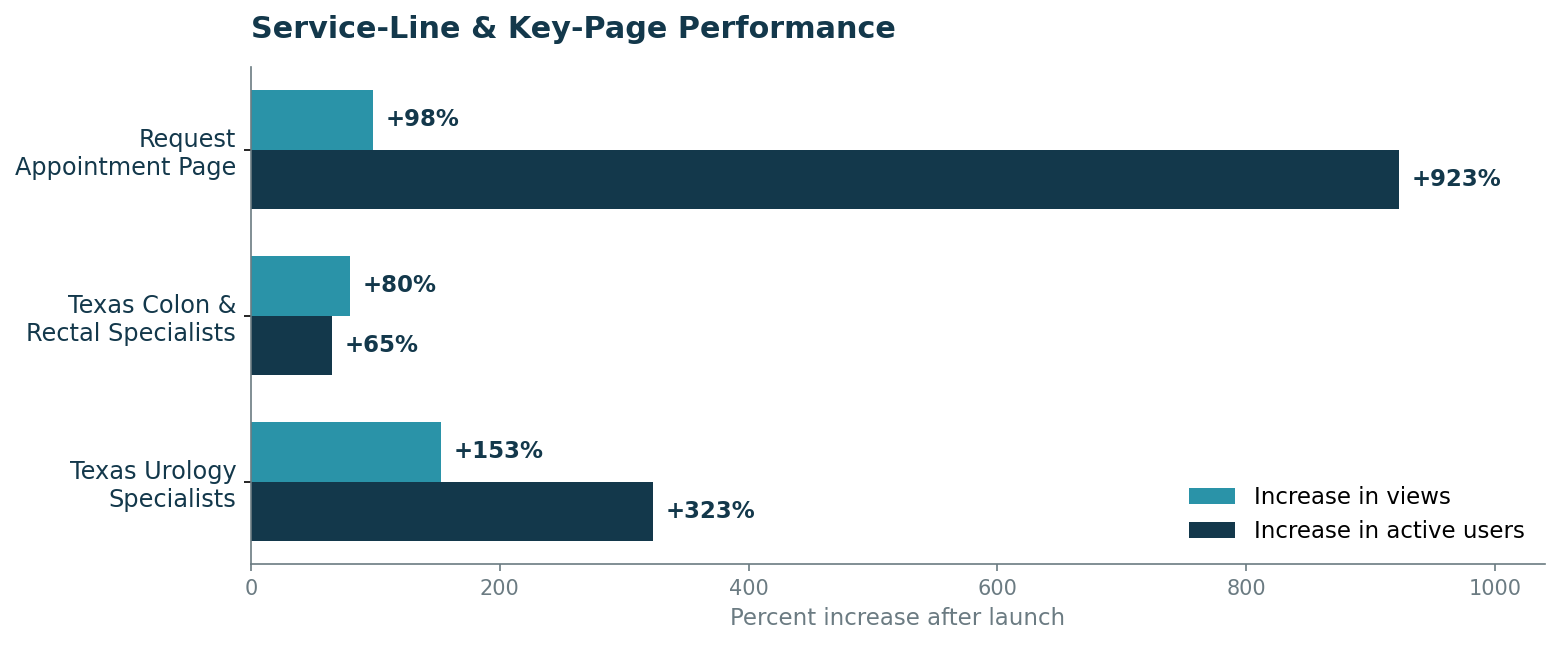
Texas Oncology - Service-Line and Key Page Performance

The service-line microsites proved the platform’s flexibility paid off. The Texas Urology Specialists experience drove a 153% increase in homepage views and a 323% increase in active users, while the Texas Colon & Rectal Specialists site saw an 80% increase in views and a 65% increase in active users.

The rebuilt provider directory turned a fragmented search into a confident decision:

  • 84.7% provider search success rate, with a zero-results rate of just 3.2%
  • An average of 41 seconds from search to provider profile
  • 96.4% profile completeness across credentials, specialties, locations, accepted insurance, languages, and appointment options
  • More than a third of profile visitors went on to begin a scheduling action

And the experience reached more people: the accessibility score rose from 68 to 97, extending high-quality access to patients and caregivers of all abilities.

Beyond the metrics, Texas Oncology gained something durable — a single, governed platform that keeps communications accurate across every property, frees teams from duplicated work, and is built to grow alongside the organization’s mission.


“Texas Oncology’s scale is exactly what makes this work matter. Unifying a statewide ecosystem onto one governed platform and structuring it so patients get real answers when they search is how digital becomes an extension of the care itself.”

— Demetrios Kontizas, CEO, Alliance Innovations

06

Ready to Transform Your Patient Experience?

Cancer care organizations across the country face the same challenges: fragmented digital properties, content that’s hard to find and harder to govern, and rising patient expectations on every device. If you’re looking to unify your digital presence into one scalable, accessible, answer-ready platform that helps patients find care and take the next step, we’d love to explore what’s possible for your organization.

Contact us to discuss how we can help you build a digital ecosystem that scales with your mission.

    Texas Oncology Digital Ecosystem Case Study | Alliance Innovations